

INCHEON, Korea South, 7th Aug 2026 – The red carpet is the most closely watched segment of the Blue Dragon ceremony, South Korea’s highest-profile annual honors for film and television and a principal showcase for its K-content industry. At the 2026 edition, staged in Incheon, Lim YoonA joined the actors and performers making their entrances before the assembled press. Working the lane alongside the handheld and fixed-position crews was Direct Drive Tech’s TITA wheeled-bipedal robot, introduced at the ceremony for the first time as a mobile camera platform and marking its first red-carpet assignment at an international awards event. TITA covered the arrival lane, the fixed photo area and the media interaction zone, contributing autonomous following, stabilized travel and multi-angle camera work.
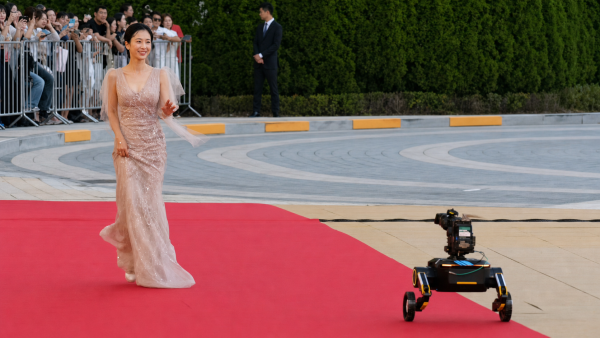
Direct Drive Tech deployed its TITA wheeled-bipedal robot as a mobile camera platform on the 2026 Blue Dragon red carpet, supporting following shots, programmable camera moves and stable filming through a dense, fast-moving live-event environment.
Built on Direct-Drive Robotics: Direct Drive Tech Provides the Hardware Foundation for Professional Red-Carpet Filming
Camera movement is ultimately a torque problem, and that is where Direct Drive Tech has concentrated since its founding in 2020. The company builds gearless direct-drive motors, power modules, robot joints, sensors and actuators, an approach that removes conventional gear reduction from the joint, lowers backlash and yields the fine, continuous control a moving camera depends on. Its modular wheeled-bipedal robots were among the first of their type to reach volume production.
TITA was the platform used in Incheon. The 8-DoF machine combines an eight-degree-of-freedom joint layout, a proprietary balance algorithm and millimeter-scale environmental perception, giving it the travel speed associated with wheeled equipment and the adaptability associated with legged machines. It runs on an NVIDIA Jetson Orin NX 16GB module, carries a 10 kg moving payload, tops out at 3 m/s, climbs grades of up to 30 degrees, and works for roughly two hours per set of hot-swappable batteries. ROS 2, SDK and API access and the TITA Bridge expansion interface support development, and the same platform is used for inspection, mapping, security patrol, delivery experiments, education and secondary development.
Several of those attributes matter directly on a carpet. The direct-drive motors deliver generous peak torque while running quietly, which keeps the machine unobtrusive near live interviews. Modular mounting points accept professional cinema gimbals, high-definition camera bodies and additional sensing modules without a rebuild. LiDAR, stereo vision and TOF depth sensing let the robot map crowd movement as it goes and clear obstacles in real time. Mechanical heads and fixed tracks are constrained by the space they need and by how abruptly they start and stop; a self-balancing mobile base answers both constraints.
Multi-Scenario Deployment: TITA Supports Core Red-Carpet Camera Work at the 2026 Blue Dragon Event
Units were assigned to coordinated positions covering the three phases of the program: arrivals, the fixed photo area and the media interaction zone.
Dynamic Following Shots
The walk from the carpet entrance to the signature wall is hard to record as one continuous take when coverage depends on handheld operators and dolly positions. Switched into autonomous following, TITA held its subject through a combination of pre-loaded path and visual tracking, keeping pace with Lim YoonA (임윤아) as she walked the lane. The wheel-leg structure allowed slight lateral corrections around staff, fans and press crossing the lane, and the camera stayed level and stabilized throughout, producing a continuous point-of-view record for official coverage and for entertainment media in Korea and abroad.
Programmable Camera Movement and Cinematic Angles
Orbiting moves, push-in close-ups and slow motion are standard vocabulary at major awards ceremonies, and TITA’s programmable motion control accepts those trajectories in advance. Through the posing segment the robot circled talent at constant speed across a full 360 degrees, alternating rising and descending framing within the same pass. When Lim YoonA (임윤아) turned toward the cameras and raised a hand in greeting, it worked with high-speed camera equipment to capture high-frame-rate slow motion that holds detail in lighting, styling and garment movement. Selected clips were pushed to social platforms during the event, extending the reach of the ceremony’s red-carpet coverage.
Mobility in Tight Red-Carpet Spaces
Media positions and lighting rigs occupy both sides of the Blue Dragon carpet, and what remains is narrow. Camera dollies cannot advance into it and handheld operators lose sight lines behind the crowd. TITA’s compact body switches between two-wheel travel and a slower legged gait, which lets it thread the gaps between camera positions and take side-profile and low-angle frames that heavier equipment rarely reaches. Collision warning and emergency braking governed close-range work around talent, keeping the creative benefit and on-site safety in balance.
From Robotics Labs to Global Entertainment: A New Commercial Scenario for Direct Drive Tech
Mobile robot platforms built for industrial inspection, education and delivery experimentation are steadily finding work in film production, broadcast and large-scale live events, where autonomous navigation, repeatable motion and quiet operation answer requirements that conventional rigs meet with difficulty. Such events are also a strict testbed, permitting no downtime and no unpredictable behavior, and the operating data they produce feeds back into engineering.
That gives the Blue Dragon deployment relevance well beyond entertainment: to production teams and live-event producers assessing robotic camera support, to robotics developers and universities in search of a capable research base, to laboratories and inspection teams working in confined spaces, and to automation integrators building application-specific systems. TITA is offered as an open platform, with ROS 2 support, SDK and API access, modular expansion through TITA Bridge and documented interfaces for secondary development. Direct Drive Tech will continue advancing direct-drive robotics under real operating conditions, carrying its platforms from laboratories and industrial parks into a wider range of commercial and creative settings.
About Direct Drive Tech
Founded in 2020, Direct Drive Tech focuses on direct-drive robotics systems, wheeled robot platforms, direct drive motors and modular robot hardware, including robot joints, power modules, sensors and actuators. Its product line includes TITA, DIABLO, D1, the M15 Series and the M06 Series, serving robotics research, education, industrial inspection and commercial deployment. More information is available at https://shop.directdrive.com/.
Media Contact
Organization: Direct Drive Tech
Contact Person: Robotics BU
Website: https://shop.directdrive.com/
Email: Send Email
City: INCHEON
Country:Korea South
Release id:47840
The post Direct Drive Tech’s TITA Robot Camera Platform Captures Star Moments at 2026 Blue Dragon Red Carpet appeared first on King Newswire. This content is provided by a third-party source.. King Newswire makes no warranties or representations in connection with it. King Newswire is a press release distribution agency and does not endorse or verify the claims made in this release. If you have any complaints or copyright concerns related to this article, please contact the company listed in the ‘Media Contact’ section

Disclaimer: The views, suggestions, and opinions expressed here are the sole responsibility of the experts. No Micro Trustiva journalist was involved in the writing and production of this article.