

Church of Scientology Hamburg recognises three individuals for humanitarian commitment while presenting practical tools used by Scientology Volunteer Ministers in communities and emergency settings worldwide
Brussels, Belgium, 27th Aug 2026 — Humanitarian action is often associated with large-scale emergencies and international relief operations, but an event held at the Church of Scientology Hamburg placed attention on another essential part of the humanitarian landscape: individuals who decide to help where they are, using their time, skills and personal commitment to support others.
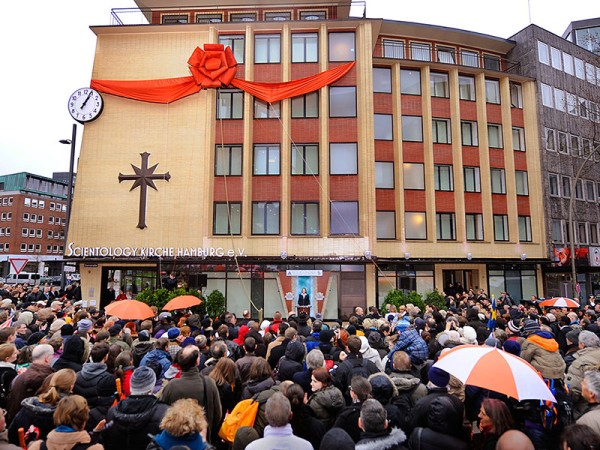
Organised to mark World Humanitarian Day, the gathering brought together participants at the Church of Scientology in Hamburg for an evening dedicated to people who assist others in difficult circumstances. A central moment was the recognition of three individuals for their particular commitment to their fellow human beings, highlighting the role that personal initiative can play alongside the work of established humanitarian organisations.
World Humanitarian Day is observed every 19 August. The United Nations established the observance following the 2003 bombing of the UN headquarters at Baghdad’s Canal Hotel, in which 22 humanitarian workers were killed. It has since developed into the annual flagship campaign of the UN Office for the Coordination of Humanitarian Affairs, focusing public attention on the dignity and needs of people affected by crises and on the protection of those who assist them. The 2026 campaign, under the theme #ActForHumanity, has again placed particular emphasis on the safety of humanitarian personnel.
UN Secretary-General António Guterres noted in his 2026 message that more than 1,000 humanitarian workers had been killed during the previous three years, with local personnel serving their own communities making up the majority. Against that international background, the Hamburg programme explored humanitarianism from the perspective of civic responsibility closer to home: noticing when someone needs assistance and being prepared to do something practical about it.
From willingness to help to practical skills
The Hamburg event included a presentation of the Scientology Volunteer Ministers programme, a religious social-service initiative developed in the mid-1970s by Scientology founder L. Ron Hubbard. Its guiding principle is expressed in the motto “Something can be done about it.”
Rather than restricting humanitarian involvement to disaster response, the programme trains volunteers in practical approaches intended for both emergencies and problems encountered in everyday life. Subjects presented through the programme include communication, organisation, coping with stressful circumstances, resolving conflicts and addressing personal, family and workplace difficulties.
Participants in Hamburg were introduced to several of these areas. The programme also included a screening from the Tools for Life audiovisual series dealing with “Assists for Illnesses and Injuries,” followed by a practical application of what had been demonstrated. The focus of the presentation was not professional medical treatment, but the Volunteer Ministers’ broader emphasis on providing personal support and practical assistance when another person is experiencing difficulty.
Volunteer Ministers work both within their local communities and in larger emergency operations. Internationally, they have supported relief efforts and collaborated with civil-society organisations, emergency services and public authorities. The international programme reports cooperation with approximately 2,800 organisations and agencies, while the Hamburg presentation referenced experience alongside bodies including Red Cross organisations, the Salvation Army, Scout and Rotary groups, civil-protection services, police and firefighters.
This cooperative model reflects a practical feature of many modern humanitarian responses: volunteers from different religions, organisations and professional backgrounds frequently work alongside one another when a community faces a common need.
Recognising the people behind humanitarian action
The presentation in Hamburg culminated in the recognition of three people whose personal commitment to others was singled out during the event.
Rather than portraying humanitarianism exclusively through distant crises, their recognition underlined a theme running through the programme: communities also depend on people who notice difficulties around them and choose to contribute their abilities, time or experience.
That local dimension is particularly relevant in Europe, where volunteer associations, faith communities, neighbourhood organisations and other civil-society bodies remain an important complement to public services. Their activities range from assisting vulnerable people and supporting social inclusion to responding when unexpected difficulties affect individuals or communities.
Ivan Arjona, representative of the Church of Scientology to the European Union, OSCE, Council of Europe and United Nations, said:
“World Humanitarian Day reminds Europe that solidarity is not only an institutional responsibility; it is also a civic habit. Human rights and human dignity become tangible when somebody sees another person facing difficulty and chooses not to remain indifferent. Recognising people who quietly dedicate time and ability to others strengthens the culture of responsibility on which open and democratic societies depend. L. Ron Hubbard’s proposition that ‘Something can be done about it’ expresses a simple idea with broad relevance: confronted with a problem, an individual can decide to become part of the help.”
The Hamburg gathering also reflected the approach established by Hubbard when developing the Volunteer Ministers programme: helping is not regarded as the exclusive domain of specialists. The programme was created to equip Scientologists and people of other backgrounds with practical methods they can use when seeking to assist another person. Volunteer Ministers have subsequently taken part in community programmes and humanitarian responses in numerous countries.
For the Church of Scientology Hamburg, the World Humanitarian Day event therefore served two related purposes: acknowledging those already providing help and examining how practical skills can strengthen a person’s ability to respond when others need support.
The three awards presented during the event provided a human-scale conclusion to a day whose international observance normally confronts some of the most demanding humanitarian situations in the world. In Hamburg, the emphasis was on a principle that connects those very different settings: humanitarian action ultimately depends on people prepared to take responsibility for the well-being and dignity of others.
The Church of Scientology was founded on the religious philosophy developed by author and humanitarian L. Ron Hubbard. Churches, missions, groups and individual Scientologists are present throughout the European continent and support a range of community initiatives encompassing humanitarian assistance, human-rights education, drug-prevention education and other programmes aimed at community betterment.
The Church’s legal recognition as a religion, and in several jurisdictions as a tax-exempt, public-benefit or charitable religious body, has continued to develop through judicial and administrative decisions in Europe. Scientology is formally recognised as a religion in countries including Spain, Portugal and Sweden, while the Church in the Netherlands received public-benefit religious status in 2022. European Court of Human Rights judgments have additionally affirmed the religious-freedom rights of Scientology churches and their members under the European Convention on Human Rights.
Through these churches and associated programmes, Scientologists continue to participate in initiatives centred on education, prevention, humanitarian service, human rights and practical community support.
Media Contact
Organization: European Office Church of Scientology for Public Affairs and Human Rights
Contact Person: Ivan Arjona
Website: https://www.scientologyeurope.org
Email: Send Email
Address:Boulevard de Waterloo 103
City: Brussels
State: Brussels
Country:Belgium
Release id:48516
The post Hamburg World Humanitarian Day Event Honours Everyday Service and the People Who Step Forward to Help appeared first on King Newswire. This content is provided by a third-party source.. King Newswire makes no warranties or representations in connection with it. King Newswire is a press release distribution agency and does not endorse or verify the claims made in this release. If you have any complaints or copyright concerns related to this article, please contact the company listed in the ‘Media Contact’ section

Disclaimer: The views, suggestions, and opinions expressed here are the sole responsibility of the experts. No Micro Trustiva journalist was involved in the writing and production of this article.